
Food waste is often blamed on poor planning, but the real issue may lie in how we store our food. We speak to Sicelo Champion from leading appliance manufacturer, Miele, on how refrigeration design greatly influences freshness, spending and sustainability in South African homes, where smarter cooling can mean less waste and better value.
Food waste has long been reduced to a question of discipline. Plan better. Shop smarter. Waste less. But this narrative misses a critical point. What if the real issue is not how we shop, but how we store? In many homes, the difference between food that lasts and food that is thrown away comes down to refrigeration performance. “Food waste is too often blamed on behaviour alone,” says Sicelo Champion, Head of Brand Activation and Own Retail at Miele South Africa. “In reality, storage conditions play a decisive role in how long food remains usable.”
In South Africa, where rising food costs are placing pressure on household budgets, this distinction matters more than ever. The ability to preserve freshness is directly linked to how efficiently a household can manage its spend. When refrigeration maintains consistent temperature and humidity, it enables better planning and reduces unnecessary waste. When it does not, even the most carefully considered shopping list can unravel. “When your refrigeration supports freshness, it changes how you buy, store and cook,” Champion adds. “It gives you control, and ultimately, it helps reduce waste in a meaningful way.”
Food waste starts with storage
Households sit at the centre of the global food waste problem. According to the United Nations Environment Programme Food Waste Index Report (2021), around 931-million tonnes of food are wasted every year, with as much as 61% of this coming from homes. On average, this equates to roughly 74kg of food per person annually, much of it lost simply because it spoils before it can be used. This points to a simple, but often overlooked truth: freshness is not only about buying wisely, but about storing correctly.
“Food waste is often seen as a consumer issue, but it is equally a design challenge,” says Champion. “If refrigeration cannot maintain consistent conditions, food simply will not last as long as it should.”
Freshness that translates into savings
Meal planning depends on one thing above all: consistency. Fresh produce bought on a Sunday needs to hold its quality until midweek, and meat stored for later in the week should be just as usable as the day it was purchased. When ingredients deteriorate unpredictably, even the best-laid plans fall apart, often leading to unnecessary waste and repeat shopping.
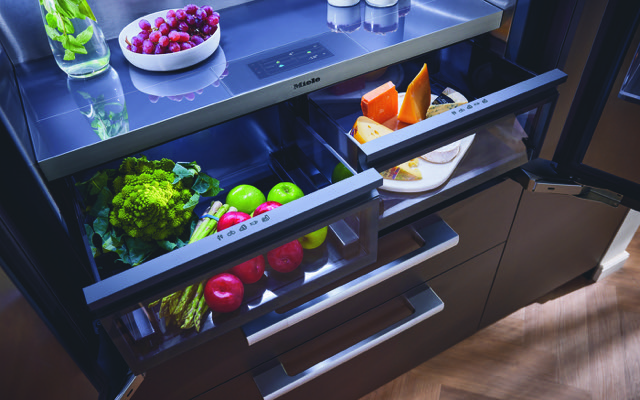
This is where advanced refrigeration shifts the equation. Miele’s refrigeration appliances for example, are engineered to create highly controlled internal environments rather than relying on a single, uniform cooling zone like most other refrigeration appliances. Technologies from Miele such as PerfectFresh Pro and PerfectFresh Active go beyond simple temperature management by introducing dedicated freshness zones that balance low temperatures with precise humidity control.
PerfectFresh Pro maintains a stable climate just above 0°C, slowing down the biological processes that cause food to spoil, while offering adjustable humidity compartments tailored to different food types. Drier conditions are ideal for meat and dairy, where excess moisture can accelerate bacterial growth, while high-humidity zones protect fruit and vegetables from dehydration, helping them retain their structure, crispness, flavour and nutrient content for significantly longer.
PerfectFresh Active builds on this by introducing active humidification. A fine mist is released into the fruit and vegetable drawers at intervals, replenishing moisture that is naturally lost after harvesting. This prevents wilting, shrivelling and nutrient degradation, particularly in delicate produce such as leafy greens and berries. The result is not only extended shelf life, but visibly fresher food that maintains its integrity over time.
“When food stays fresh for longer, it changes how people shop and cook,” explains Sicelo Champion. “You can buy with intention, plan meals properly and reduce the need to replace spoiled items.”
A smarter way to reduce waste
Refrigeration should no longer be viewed as a passive appliance in the background of the kitchen. It is one of the most influential tools in determining how efficiently a household manages food, cost and waste. When storage conditions are inconsistent, even the most disciplined habits fall short. When they are precise, predictable and intelligently designed, they support better decisions at every stage, from shopping to cooking.
This is where Miele refrigeration stands apart. Engineered for exceptional consistency, an incredible 20-year lifespan, best-in-market efficiency, and advanced freshness technologies – Miele offers more than short-term performance, it delivers sustained value over time. For households looking to reduce waste, manage rising food costs and bring greater control to everyday living, investing in a high-performance refrigeration system is a practical and measurable step that will save you thousands in the long run.
“Refrigeration is not just about keeping food cold,” concludes Champion. “It is about preserving the value of what you buy and giving you the confidence that your food won’t spoil prematurely. That is where real impact is made.”
For more articles like this click here.
If you enjoyed this website then check out our other sites: Wedding and Function, Home Food and Travel, Thirsty Traveler, Boat Trips for Africa, Bargain Buys, Business Link.
Need help with your online marketing then visit Agency One.