By Steve Welman, Director at Gentle Genius
More than 1.1 million learners, some as young as five-years-old, experienced some form of violence at school in 2024, according to Stats SA . While this figure includes different forms of violence and should not be read as a measure of bullying alone, the 2023 Trends in International Mathematics and Science Study (TIMSS) also points to how widespread the problem is: 48% of South African Grade 9 learners were bullied about once a month, while 22% experienced it weekly.
For parents whose children are among those affected, the question is not simply how to stop the bullying. It is also how to ensure that their children become secure, supported, and able to focus on their learning going forward. And, as families consider their schooling options for 2027, home education deserves to be part of this conversation.
“Parents should not feel that their only choice is between sending a child back into an environment where they feel unsafe, or compromising on their learning,” says Steve Welman, Director at Gentle Genius. “Home education can provide a way to remove a child from a harmful environment while continuing with a structured, quality education.”
Keeping education on track
Changing a child’s learning environment is a significant decision, but home education offers more than an escape from an unsafe school setting. It gives families the opportunity to create a learning environment around a child’s individual needs, with greater flexibility over pace, routine, and how learning is approached. For a child whose confidence has been affected by bullying, this breathing room and individual attention can make a meaningful difference.
Of course, flexibility needs to be supported by academic credibility. A quality home-education programme should provide a clear curriculum, structured lessons, appropriate learning resources, and regular, meaningful assessment, so that parents can see what their children are learning and how they are progressing. A CAPS-aligned framework also helps ensure that learning remains aligned with national educational standards.
Parents choosing home education for a learner subject to compulsory school attendance must apply to the head of their provincial education department for registration. Enrolling with a curriculum provider does not replace that application. See the Department of Basic Education’s home-education information.
“Home education gives parents a more active role in shaping their child’s learning, but it should not mean they have to design the education themselves,” says Welman. “With the right curriculum and resources, they can offer their children a structured learning experience that can be individualised to their specific needs. This combination of academic direction and flexibility is a real strength of home education.”
Enabling closer parental involvement
Learning at home also does not mean learning in isolation. Children can build friendships and develop social skills through sport, clubs, music, homeschool groups, and other community activities. In turn, parents might have more opportunity to be involved in these experiences, if necessary, and to help their children build positive relationships in environments where they feel comfortable.
The same involvement can help parents guide their children’s online lives. Cyberbullying through messaging groups, social media, and gaming can be difficult to escape but, while home education does not remove the risk, parents who are able to spend more time with their children, and who have greater visibility of their children’s online interactions, are more able to identify problems, talk about safe behaviour, and intervene timeously.
Addressing academic and emotional consequences
There is a measurable relationship between bullying and academic performance. In the TIMSS study, learners who reported being bullied weekly achieved average scores of 361 in Maths and 307 in Science. Those who were rarely or never bullied scored 422 and 404 respectively. These differences do not establish that bullying alone caused lower performance, but they underline the potential impact of a child’s school experience on their ability to learn.
The consequences of bullying are also not necessarily confined to the time a child spends at school. An article published in World Psychiatry shows strong evidence that bullying victimisation is associated with depression, anxiety, suicidal ideation and behaviours, and poorer general health.
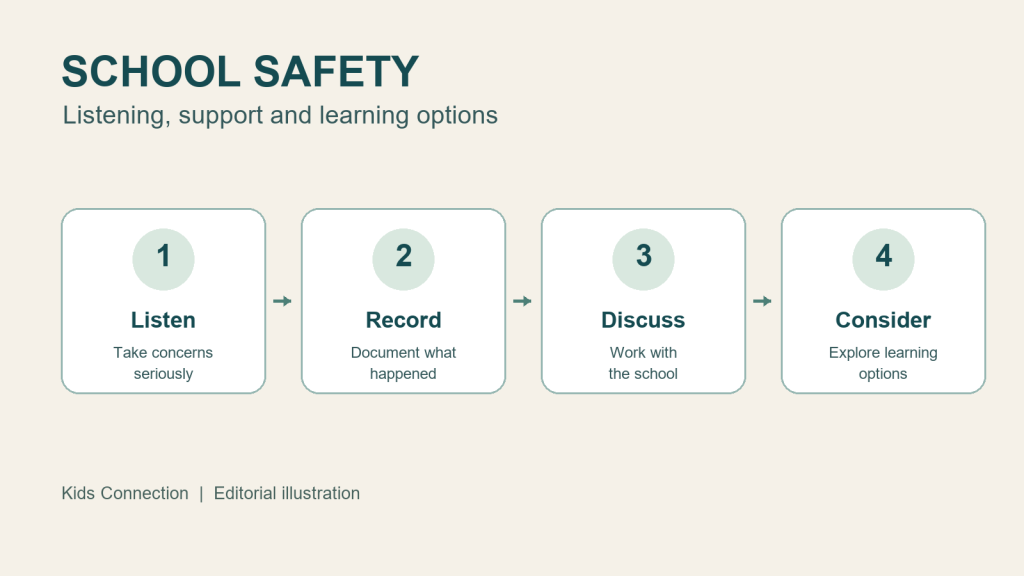
“Children need to know that they will be taken seriously when they speak about something happening to them,” says Welman. “Parents should listen, document what has happened and raise concerns with the school. But, if a child continues to feel unsafe, it is reasonable to consider whether a different learning environment would be better for them.”