
By Kate Groch
Screen time is bad for children, right? Artificial intelligence is killing critical thinking, correct? I beg to differ.
In the rural areas where I’ve worked as an educator for the past 20 years, technology is being used to make young people’s worlds bigger and brighter. It’s connecting them to opportunities that otherwise would be beyond their reach.
I’m very aware of the debates over the harm technology and screen time can inflict on children. I am also not advocating the unrestricted, irresponsible use of tech at the expense of a balanced lifestyle.
But different socio-economic contexts demand different lenses on the issue. For example, in the remote Mpumalanga and Free State villages where our education non-profit operates, children and young adults seldom have always-on access to smartphones, tablets and computers, let alone Wi-Fi. They walk kilometres to school, do household chores and play soccer and netball in their spare time. Spending too much time on smart gadgets is generally not an issue.
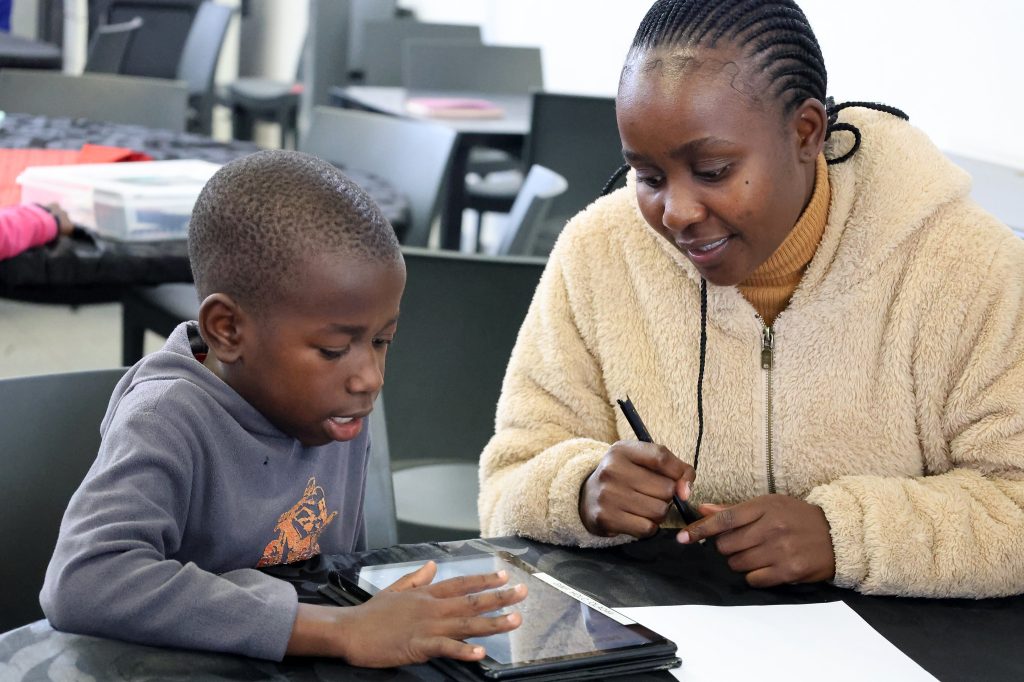
So, when our facilitators help Grade 4s learn how to spell, code and do maths problems on a tablet, that screen time is a novelty. It opens up new worlds for them. And they love every minute of it.
Giving rural kids a fighting chance
Demystifying tech by integrating it into learning means that, as these rural children get older and we guide them in using technology to start a business, submit a CV or fill out a university application form, they have a fighting chance of running out on the same playing field as their urban peers.
I’m talking about a young adult who, after being exposed to tech-led learning while in primary school, is now teaching coding and robotics at a high school in his Bushbuckridge village. I’m talking about a rural school leaver being “interviewed” by an AI avatar in a close simulation of a job interview.
I’m talking about a rural-schooled IT whizz who is consulting remotely from Hazyview for a global firm as part of a business process outsourcing operation. And I’m talking about a young woman who lives on the fringes of a game reserve (but has never seen a lion in the wild), using a virtual reality (VR) headset to go on a digital safari and dreaming of a career as a game ranger or field guide.
Tech is an enabler of opportunity, not a barrier. Without it, rural youth run the risk of double exclusion: being located far from urban innovation hubs and being displaced by the AI-driven economy of the future. Tech can also empower them to stay and contribute to their communities rather than migrate to cities in search of jobs.
A tablet or phone is the new ‘pen’
As a teacher I’ve seen the maxim, “Give a child a pen or pencil and watch their creativity flourish,” come true many times. Today, that symbolic pen or pencil might be a smartphone, a tablet or a PC, but the principle remains the same.
And here’s the thing: if we don’t embrace the opportunities that tech can offer, we may end up creating a new generation of “haves” and “have-nots”: those with access to the digital economy (and the jobs it offers), and those without.
I’m a strong believer in children learning to navigate the digital world through facilitated but less regulated play. By “less regulated”, I mean we should remove overly restrictive guardrails while still exercising responsible oversight, because we want to expand a child’s world and not shrink it.
And by the “facilitated” exploration of digital worlds, I mean guided and even accompanied play – whether it’s by a parent or an educator. Let’s transform their screen time from a passive, solitary experience into a collaborative space where they learn by creating new things.
For example, our rural non-profit has six digital learning campuses where “high-tech” (digital-led) learning is blended with “high-touch” (human-led) interactions with facilitators from these young people’s communities. This creates a safe, familiar space to experiment with tech tools while retaining the vital human element.
Enter and explore your child’s tech universe
Equally, parents need to become active participants in their children’s tech use, taking the time to enter into virtual worlds with them and see how they create phenomenal avatars, cities and entire universes.
Imagine what that creativity could accomplish if it could be used to solve real-world problems? We should be inspiring the youth to make a difference in the communities where they live, where youth-led innovations can be game-changers.
As educators and parents, we are uniquely placed to encourage young individuals to embrace the interconnectedness of society. At Good Work Foundation, for example, we don’t teach tech in isolation but rather as part of a holistic learning environment that includes movement, mindfulness, good citizenship, conservation and creativity in parallel with digital-led discovery.
The tech itself isn’t the problem; it’s the intention of the person using it that can be positive or negative. I believe good intentions will follow naturally if a young person has a strong sense of belonging and community.
Young South Africans need the confidence to step out into the world as thoughtful and well-rounded citizens, connected to their fellow humans and mindful of the impact they can have on society. So instead of demonising AI, for example, let’s rather show them how to be entrepreneurial and use AI for good.
Don’t try to keep the lid on the tech revolution. Take the lid off. Encourage children to play and have fun with digital tools. Trust them. Guide them. Give them agency. If any technology, be it AI, VR or augmented reality, is making a young person’s world bigger and better and connecting them to opportunity, it should be embraced, not feared.
For more articles like this click here.
If you enjoyed this website then check out our other sites: Wedding and Function, Home Food and Travel, Thirsty Traveler, Boat Trips for Africa, Bargain Buys, Business Link.
Need help with your online marketing then visit Agency One.