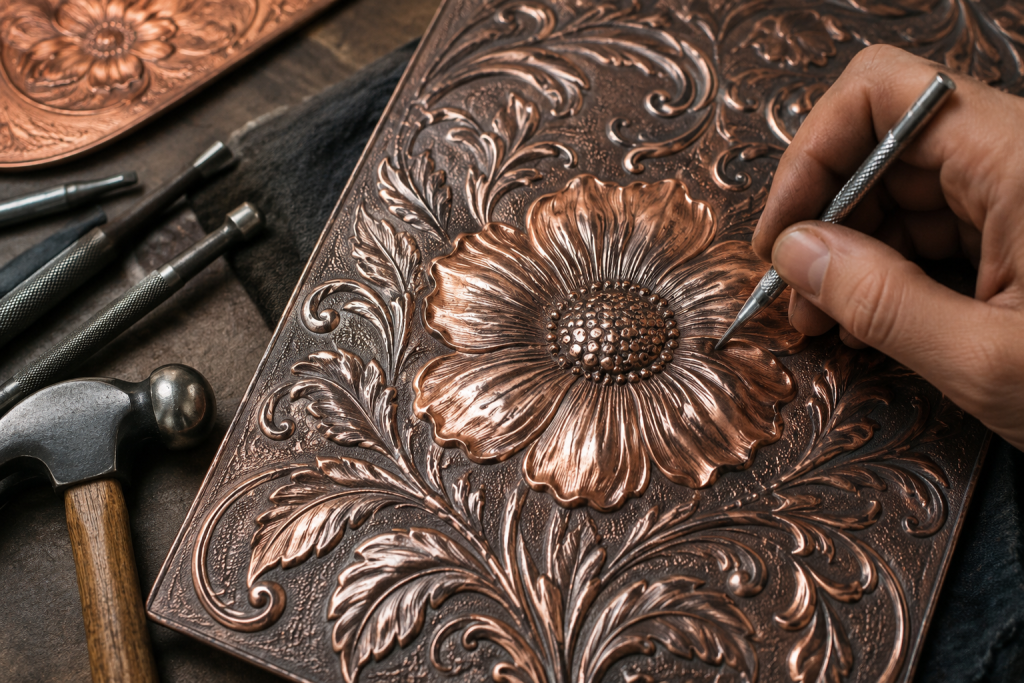

Metal embossing is the art of creating raised or recessed designs on a thin sheet of metal. With only a few basic tools, a flat piece of aluminium, copper, pewter or brass can be transformed into a decorative artwork filled with texture, detail and character.
The craft is surprisingly accessible to beginners. Simple designs can be completed at home, while more ambitious projects offer experienced artists almost unlimited opportunities to develop their skills.
“Metal embossing is wonderfully absorbing,” says Nelmari Oosthuysen, owner of A Peace of Art. “As you slowly work each line and shape into the metal, your attention becomes completely focused on the creative process. It is an excellent way to quieten the mind and step away from the pressures of everyday life.”
The origins of metal embossing
Metal embossing has been practised for thousands of years. Ancient craftspeople discovered that soft, malleable metals could be shaped by pressing or hammering them from either side.
Two traditional techniques are closely associated with metal embossing. Repoussé involves working the metal from the reverse to create a raised design, while chasing is performed from the front to define outlines, add texture and create recessed details. The techniques are frequently combined in the same artwork. The word repoussé comes from a French term meaning “pushed up” or “pushed back.”
Examples of embossed and repoussé metalwork have been found in the Middle East, Ancient Egypt, Greece, Rome, India and the Americas. The techniques were used to decorate jewellery, ceremonial masks, armour, shields, vessels and religious objects. Famous examples include the gold burial mask of Tutankhamun and the silver Gundestrup Cauldron. On a far larger scale, sections of the Statue of Liberty were also formed from repoussé copper.
Although traditional metalworkers used hammers, punches, pitch and heat, hobby embossing has made the art much easier and safer to explore. Today, beautiful decorative pieces can be created using thin metal sheets and simple handheld tools.
Tools needed for metal embossing
A beginner does not need a large collection of expensive equipment. A basic metal-embossing toolkit normally includes:
Embossing tools
Embossing tools have rounded tips in different sizes. Larger tips are used to raise broad areas, while smaller tips help create fine lines and details. A ball stylus or ball-ended modelling tool is particularly useful.
Fine-point stylus
A fine stylus is used to trace designs, define edges and add delicate lines. The point should be firm but not so sharp that it cuts through the metal.
Texture tools
Texture wheels, patterned punches, stippling tools and other shaped tips can be used to create dots, lines, scales, leaves and decorative backgrounds. Beginners can also experiment with household items, provided they do not have dangerously sharp points.
Soft working surface
Metal must be placed on a surface that gives slightly when pressure is applied. Craft foam, felt, a mouse pad or folded newspaper can all be used. A firmer surface is helpful when flattening areas or sharpening details from the front.
Scissors or metal snips
Thin craft metal can usually be cut with sturdy scissors. Small metal snips may be needed for slightly heavier sheets. Care must be taken because cut metal can have sharp edges.
Ruler and masking tape
A ruler helps with borders and geometric designs, while masking tape holds the metal and pattern in place as the design is transferred.
Supplies used in metal embossing
The most important supply is the metal sheet itself. Aluminium is often recommended for beginners because it is affordable, lightweight and easy to shape. Copper and pewter are also popular, while brass provides a rich golden appearance but may require more pressure.
Embossing metal is available in different thicknesses. Very thin foil is easy to work but can tear or crease, while thicker metal is stronger but requires more effort. A medium-weight craft sheet is generally a good starting point.
Other useful supplies include:
- Tracing paper and a pencil
- Printed patterns or original drawings
- Acrylic paint, alcohol inks or coloured patinas
- Black antiquing medium or shoe polish
- Cotton buds and soft cloths
- Clear varnish or protective sealer
- Cardboard, wood, canvas or another base for mounting
- Strong craft adhesive or double-sided tape
- Filler paste, wax or silicone for supporting deeply raised areas
Metal embossing can be incorporated into greeting cards, framed artworks, jewellery, decorative boxes, book covers, ornaments, wall hangings and mixed-media projects.
Basic metal-embossing techniques
Begin with a simple pattern featuring clear lines and reasonably large shapes. Leaves, flowers, birds and geometric designs are all suitable for a first project.
Transfer the design
Place the metal on a soft working surface. Position the pattern over it and secure both with masking tape. Trace the main lines gently with a stylus. Avoid pressing too hard during the first pass.
Remove the paper and check that the complete design is visible on the metal.
Create the raised areas
Turn the sheet over and use a rounded embossing tool to press gently inside the areas that should be raised. Work gradually, making several light passes rather than trying to create the full depth at once.
Gentle circular movements help stretch the metal evenly and reduce the risk of dents or tears.
Refine the design from the front
Turn the metal back to the front and place it on a slightly firmer surface. Trace around the raised areas to sharpen their outlines. Recessed lines, dots and other details can now be added.
Alternating between the front and back allows the design to develop in layers. This combination of raising and defining is the hobbyist’s version of repoussé and chasing.
Add texture
Texture creates contrast and makes raised elements stand out. The background can be filled with dots, cross-hatching, swirls or repeated patterns. Texture should be added patiently and consistently.
Apply colour or an antique finish
The natural metal can be left visible, polished or coloured with suitable paints and inks. An antiquing medium can be worked into the recessed areas and then wiped from the raised sections. This darkens the details and gives the work an aged appearance.
Once complete, the metal can be sealed and mounted onto a firm backing.
Take your time
One of the greatest pleasures of metal embossing is its unhurried nature. Each line is formed by hand, and a design gradually emerges through small, repeated movements. There is no need to rush.
“Art gives us permission to pause,” says Nelmari. “When we become involved in making something with our hands, we stop dwelling on everything else that demands our attention. That sense of calm is one of the most valuable things a creative hobby can offer.”
Metal embossing also teaches patience. Pressing too firmly can damage the sheet, while controlled pressure produces smooth, attractive results. Mistakes can often be incorporated into the design with an extra line, texture or decorative feature.
“You do not have to consider yourself an artist before trying a new craft,” adds Nelmari. “Creativity develops through experimenting, learning and enjoying the process. The aim is not necessarily to produce something perfect—it is to experience the peace and satisfaction that comes from creating.”
Discover metal embossing at A Peace of Art
Whether you are looking for a relaxing new hobby, an enjoyable activity with friends or another technique to add to your creative repertoire, metal embossing is well worth exploring.
A Peace of Art offers a wide range of arts-and-crafts supplies and hosts creative activities and workshops in Port Elizabeth and Bloemfontein. Contact the team to enquire about suitable materials and upcoming workshops.
Port Elizabeth
85 Main Road, Walmer, Port Elizabeth
Telephone: 072 304 0797
Bloemfontein
7 Avenham Street, Avenham, Bloemfontein
Telephone: 076 192 1637
National contact: 082 770 9994
Email: info@apeaceofart.co.za
Facebook: @apeaceofartcreativeartsandcraftsworkshops
Instagram: @apeaceofart
For more articles like this click here.
If you enjoyed this website then check out our other sites: Wedding and Function, Home Food and Travel, Thirsty Traveler, Boat Trips for Africa, Bargain Buys, Business Link.
Need help with your online marketing then visit Agency One